
Key Points:
- Small vs large assisted living differ in scale, staffing ratios, and daily environment.
- Small communities (4–25 residents) offer consistent caregivers, personalized routines, and a homelike feel, while large communities (50+ residents) provide more amenities and social variety.
- The best choice depends on a senior’s health needs, personality, and how closely families want to stay involved.
Choosing between a big, well-known assisted living community and a smaller, home-like residence can feel like two very different futures for your loved one. Deciding between small vs large assisted living in New York often raises questions about safety, attention, and how life will feel day to day.
The comparison below examines assisted living facility size, staffing, personalization, environment, social life, and family involvement to help you sort through senior care options in New York with greater clarity and less stress.
 Understanding Assisted Living Size: What Do “Small” and “Large” Really Mean?
Across the United States, recent federal data show about 32,200 residential care communities with roughly 1.31 million licensed beds, which averages around 41 beds per community. Industry summaries based on the same data often describe the average assisted living community as having around 37–39 licensed beds.
Researchers and regulators often group communities this way:
- Small communities: About 4–25 residents
- Medium communities: Around 26–50 residents
- Large communities: More than 50 residents, sometimes 100–300 or more
In New York, Assisted Living Programs (ALPs) are licensed under state rules, and no single ALP operator may have more than 200 ALP beds, which helps keep individual programs from becoming extremely large.
Understanding how small vs large assisted living communities are defined makes it easier to compare what you see during tours.
Small vs Large Assisted Living: How Staff-to-Resident Ratios Shape Daily Care
Staffing is where community size starts to affect daily life in a very practical way. There is no federal minimum staff-to-resident ratio for assisted living, so states and individual communities set their own standards.
In practice:
- Smaller communities can more easily staff at tighter ratios, such as 1:3 or 1:4, for residents who need frequent help.
- Larger communities often assign one aide to 8–12 residents during the day and even more at night, especially outside of specialized memory care units.
Better ratios support caregiver consistency and more personalized senior care in New York.
When the same caregivers see your loved one every day, they notice small changes in appetite, mood, and mobility sooner and can flag issues before they escalate.
When you tour, it helps to ask:
- What is your staff-to-resident ratio during the day, evening, and overnight?
- How often do caregivers rotate assignments?
- How often do you rely on agency staff?
These questions reveal how community size and staffing policies work together behind the scenes.
Personalized Senior Care: How Facility Size Affects Individual Attention
Personalized senior care depends on how well a community can tailor routines to an individual rather than to broad categories in a care plan. Larger facilities often rely on standardized care plans that group residents by similar support needs.
That structure keeps operations efficient, but it can leave less room to honor preferred wake-up times, cultural or religious practices, or subtle communication styles, especially during busy shifts.
Smaller communities and more boutique assisted living models can:
- Adjust schedules around the resident instead of the hallway
- Protect quiet time for residents who feel anxious in crowds
- Respond faster when families request small changes in routines
- Keep care conferences short, with the same familiar faces at the table
National survey data show that about 42% of residential care residents live with Alzheimer’s disease or other dementias, and nearly 3 in 10 live with diagnosed depression. For many of these residents, predictable routines and individualized support feel less optional and more essential for stability.
In small assisted living communities in New York, families often meet the same nurse, aide, or manager during each visit, which makes it easier to ask questions and to track how the care plan is actually carried out day to day.
Home-Like vs Institutional: How Size Shapes the Feel of Daily Life
The size of an assisted living facility also changes how the environment feels the moment you walk in.
Large communities can look like hotels or apartment complexes. There may be grand lobbies, multiple dining rooms, and long hallways filled with activity. Many families appreciate the amenities, yet some residents experience these buildings as busy or clinical.
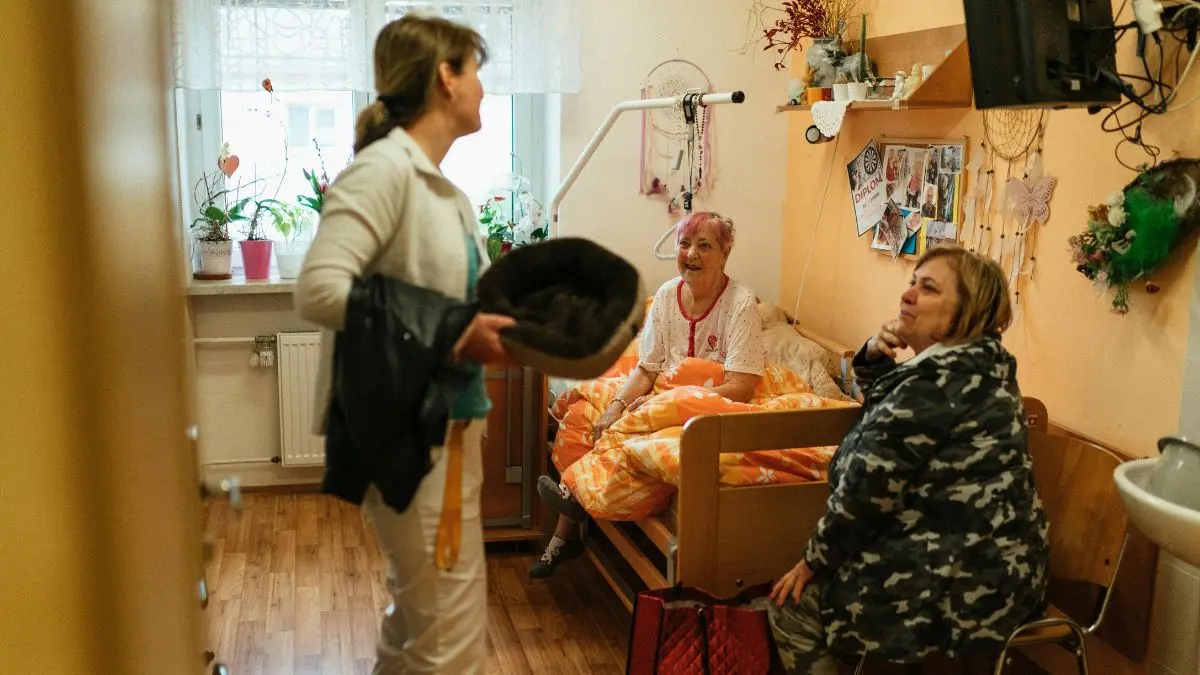
Smaller communities often lean toward a home-like assisted living environment with:
- Shared living rooms instead of large lounges
- One main dining space with familiar faces at every meal
- Shorter hallways and easier access to outdoor seating or gardens
Research on long-term care design suggests that quieter environments, more private rooms, and better control over noise improve sleep and resident satisfaction. A 2025 review of housing for older adults also identified lighting, air quality, spatial layout, and space size as design factors that influence physical and emotional health.
For many residents, especially those with dementia or anxiety, an intimate senior care setting with predictable sensory input may lower stress. For more outgoing residents who love variety and amenities like theaters or multiple dining outlets, a larger campus can feel energizing as long as they can comfortably move around it.
Social Engagement in Assisted Living: Does a Bigger Community Always Mean Better Connection?
Social life is often a deciding factor for New York families when comparing community size.
It is easy to assume that more residents automatically create better social engagement.
Larger communities usually offer:
- More structured activities in a weekly calendar
- Larger group events and outings
- Greater chances to meet people with similar interests
At the same time, studies on older adults show that social isolation and loneliness raise mortality risk, with meta-analyses estimating about a 19% higher risk of death in socially isolated adults.
Smaller communities can support deeper and more consistent friendships because:
- The same residents share meals and activities each day
- Staff can quickly notice if someone withdraws or skips activities
- New residents are introduced to everyone, not just a few peers
Large communities tend to work well for seniors who already enjoy crowds, group games, and lots of variety. Smaller settings often suit residents who prefer a few close relationships and quieter spaces.
Matching community size to your loved one’s social style usually leads to better senior social engagement than focusing only on the activity calendar.
 Family Involvement and Communication: How Size Changes Your Role
Family involvement in assisted living can look very different in a building with 20 residents than in one with 200.
In larger communities, families often:
- Communicate through the front desk or a central care coordinator
- Receive updates in scheduled meetings or formal reports
- See different staff members on each visit
In smaller settings, family involvement in assisted living may feel more direct:
- Families talk with the same caregivers who handle day-to-day care
- Concerns can be raised informally during visits and addressed quickly
- Families get a stronger sense of the community mood because they recognize staff and residents by name
For New York families who want to stay closely involved, transitioning to assisted living goes more smoothly when the community size fits how you prefer to communicate with the care team. Some larger assisted living programs invest heavily in communication tools and family portals, while smaller homes rely more on face-to-face updates.
Both can work; the question is which style your family prefers and will consistently use.
Making the Decision: Questions New York Families Can Use
There is no single checklist that works for every family, but certain questions make comparisons easier when you look at community-sized assisted living options.
You can start by asking yourself:
- Does your loved one relax more in quiet, familiar settings or in busy environments with many people nearby?
- How important is it that the same caregivers provide most of the daily help?
- Does your loved one have complex medical, dietary, or routine needs that rely on close observation?
- How often do you plan to visit in person, and how far are you willing to travel across New York?
- What is the staff-to-resident ratio on days, evenings, and nights, and how often do assignments change?
National long-term care data show that residents in smaller communities with 4–25 beds are more likely to need help with daily activities such as bathing, walking, and eating, indicating that these homes often care for residents with significant support needs.
Touring both small and large communities in person remains one of the most reliable tools for assisted living decision-making. The way a building feels, the way staff interact, and the way residents look during a normal day often tell you more than brochures or websites.
 FAQs About Assisted Living Size and Care
What is the average size of a community in small vs large assisted living?
The average assisted living community in the United States has about 41 licensed beds, with some industry summaries citing about 37 beds. Small assisted living communities usually have 4–25 beds. Medium communities usually have 26–50 beds. Large assisted living facilities often have 50–300 residents across wings.
What is one of the biggest drawbacks of assisted living?
One of the biggest drawbacks of assisted living is cost, especially in high-cost states such as New York. Assisted living fees often run in the mid-to-high four-figure range per month, and large facilities can feel impersonal when staffing is stretched, leaving residents rushed and families dissatisfied.
Do people live longer at home or in assisted living?
People may live longer at home or in assisted living, depending on their health needs, access to medical care, and social support. Home living can support a long life with reliable care and daily help. Assisted living can support longevity by reducing isolation and providing medication management, nutrition support, and health monitoring, since social isolation is linked to higher mortality risk.
Choose the Right Size By Focusing on Your Loved One’s Daily Life
When you weigh small vs large assisted living, there is no universal winner. The best setting depends on your loved one’s health, personality, and how you want to stay involved as a family.
Smaller communities often offer stronger personalization, more consistent caregivers, and a home-like rhythm that many older adults find calming. Larger communities may provide more activities, more on-site services, and a broader social scene that suits very outgoing residents.
Centers Assisted Living offers community-based assisted living programs across New York that bring clinical support together with the familiarity of smaller, relationship-centered settings. Families looking for senior care options in NY can visit to see how staff-to-resident ratios, daily routines, and shared spaces work in real time.
If you are comparing options for someone you love, you can reach out to us for a conversation, a tour, or help sorting through what your parent needs most. Our team can answer questions about care levels, community size, and available services and can help you decide which setting feels right for your family’s next step.